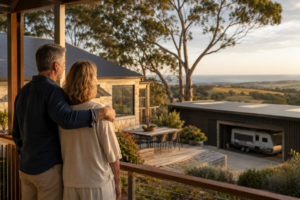
“We’re not in the bush, we’re basically in town.” We hear a version of that most weeks, usually from someone who’s just been told their block carries a bushfire overlay and can’t quite believe it. Fair enough — it doesn’t feel like a bushfire risk when you can see the water from the back deck.
But bushfire-prone-area mapping in South Australia doesn’t run on gut feel. It runs on vegetation, slope, and how close all of that sits to your build. Plenty of blocks around the Yankalilla hinterland, rural stretches of Alexandrina, and the larger rural-living allotments dotted around Victor Harbor sit inside that mapped area — even ones that feel pretty suburban day to day.
The problem: bushfire rules don’t stop at the back door
Most people think of bushfire ratings as a house problem. Something your architect sorts out, not something that touches the shed you’re planning for the back corner of the block.
The reality is more specific than that — and worth knowing before you get attached to a design. The SA Country Fire Service (CFS) has a rule that catches a lot of shed owners out:
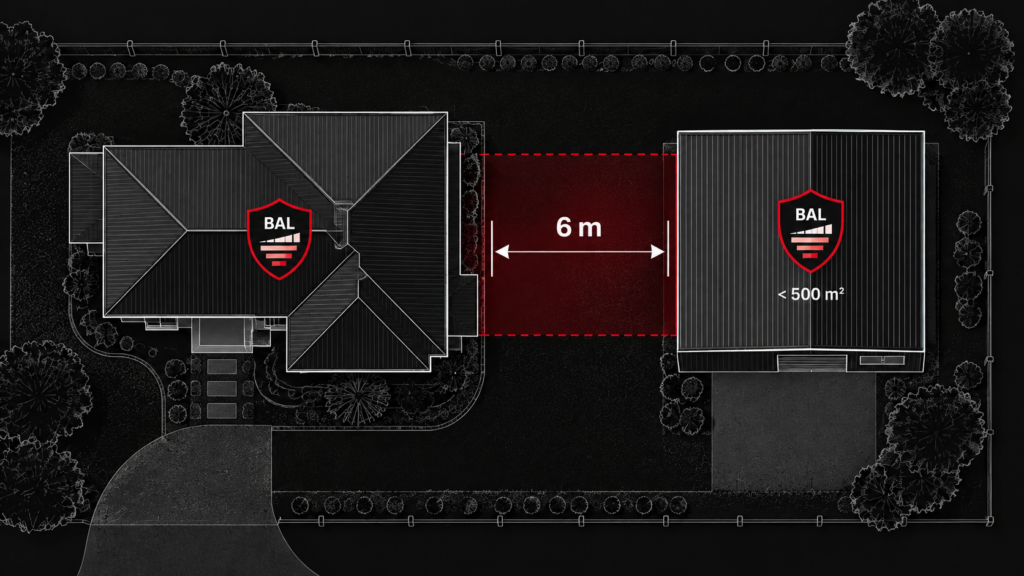
If a shed is under 500m² and sits within 6 metres of the house, it needs its own BAL assessment — because it has to be built to the same bushfire rating as the dwelling.
So a shed that feels like a completely separate project can end up carrying the same construction requirements as your house, purely because of where it sits.
The consequence of finding out too late
We’ve seen what happens when this gets picked up halfway through a project instead of at the start. The design might need reworking to a different cladding or door spec. The DA can sit waiting on a referral nobody budgeted time for. In the worst version, someone’s bought a kit shed before realising it was never spec’d for their site’s bushfire rating in the first place — and that “cheap kit” suddenly needs an expensive rethink.
None of that is a quick fix once footings are in the ground.
What a BAL rating actually is
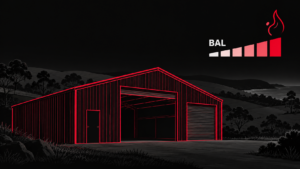
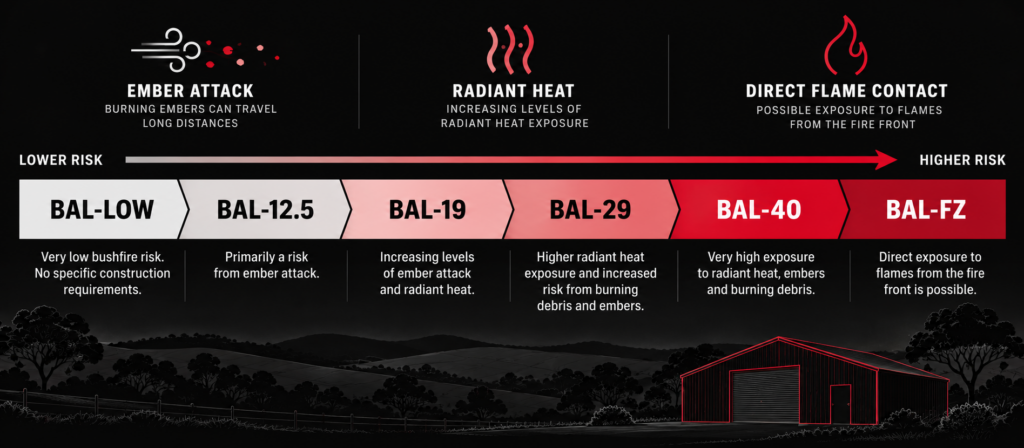
BAL stands for Bushfire Attack Level. It’s set out in the Australian Standard AS 3959, and it measures how exposed a building might be to bushfire attack — ember attack, radiant heat, and in the worst case, direct flame contact.
There are six levels, running from lowest risk to highest:
- BAL-LOW — essentially no extra construction requirements
- BAL-12.5
- BAL-19
- BAL-29
- BAL-40
- BAL-FZ (Flame Zone) — the strictest requirements
The rating depends on things like the type and density of nearby vegetation, the slope of the land underneath it, and how far your building sits from all of that.
It’s not something your builder sets, and it’s not something you can eyeball off a map. Where an overlay applies, that assessment sits with the CFS Development Assessment Service, as part of your development approval.
BAL rating vs Fire Danger Rating — worth not mixing up
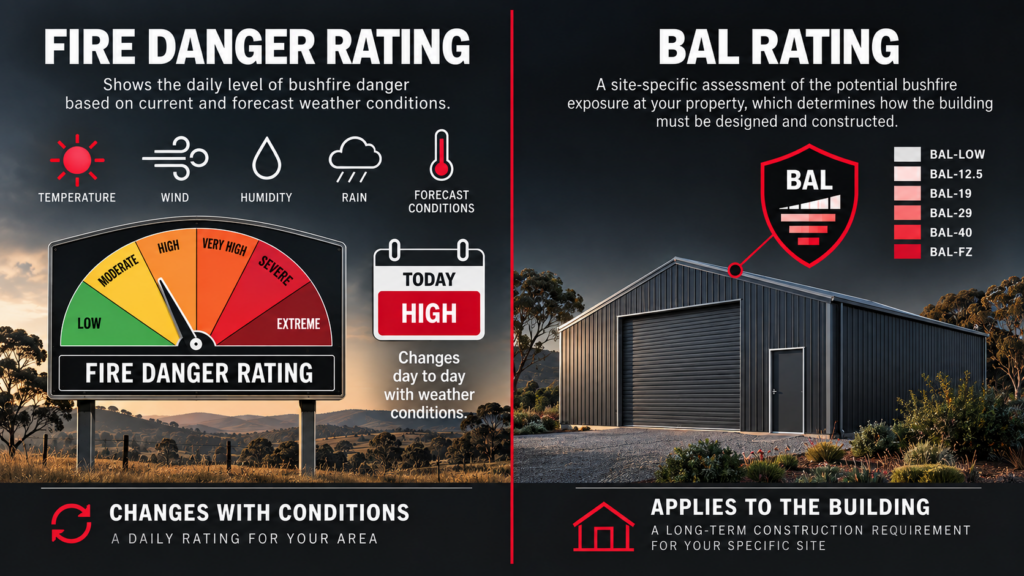
Easy one to get tangled: a Fire Danger Rating tells you how dangerous conditions are expected to be on a given day — the number you see on the roadside signs. It changes daily, and it’s about today’s weather.
A BAL rating is about the building itself. It doesn’t change every time there’s a Total Fire Ban — it’s about your shed’s construction for the life of the building.
Can the rating be reduced?
Sometimes. Because a BAL assessment weighs up vegetation, distance and slope, moving a proposed shed further from hazardous vegetation — or rethinking where it sits on a larger block — can genuinely change the outcome. It’s one reason siting is worth deciding early rather than defaulting to “wherever’s flattest.”
There are limits, though. Vegetation on the neighbour’s side of the fence still counts, and you can’t clear what you don’t own just to chase a lower number.
Our advice
- Don’t assume “in town” means you’re exempt. Some rural-living blocks close to Victor Harbor and Yankalilla still carry the overlay, even where it doesn’t feel remote.
- Remember the 500m²/6m rule. If your shed is smaller than 500m² and within 6 metres of the house, plan on it needing the same rating as the dwelling — not a lesser one.
- Check the overlay early, not after you’ve picked cladding. We run this through the SA Property and Planning Atlas as one of the first steps on every quote — a five-minute check that can save a lot of redesign later.
- Get the BAL confirmed properly, not estimated. An online tool or a general area map is a starting point, not a rating. If your site needs one, it comes through the CFS referral process.
Where this leaves you
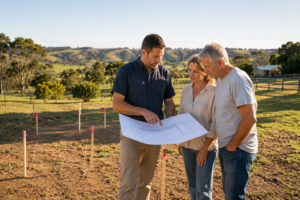
If you’re planning a shed, garage or carport anywhere on the Fleurieu and you’re not sure whether your block carries a bushfire overlay — or how close is too close to the house — that’s one of the easiest things to check before you go too far down the design path. It’s also exactly the kind of thing we check as a matter of course, not an extra you have to remember to ask for — see our rundown of the shed regrets we hear over and over again for more on planning ahead.
If your block does come back with a rating, the follow-up questions are usually: what does that actually change, and does it still apply if the shed sits well away from the house? We’ve covered both — what BAL-12.5 and BAL-19 actually mean for a steel shed, and whether a shed more than 6 metres from the house still needs its own rating.
If you’d like us to check your address before you commit to a design, we’re happy to help.