The National Construction Code (NCC) has all Performance Requirements for the construction of buildings, achieving nationally consistent, minimum necessary standards of relevant, health, safety (including structural safety and safety from fire), amenity and sustainability goals efficiently.
The NCC defines buildings in 10 Building Classes. Sheds generally fall into class 6, 7, 8, 9 or 10a depending on their intended use.
Class 1 Building: Class 1 buildings are houses. Typically they are standalone single dwellings of a domestic or residential nature. ShedEx Fleurieu is able to design a “shed” as a “house”.
Class 2 Building: Class 2 buildings are apartment buildings or a single storey attached dwelling where there is a common space below. For example, two dwellings above a common basement or carpark.
Class 3 Building: Class 3 buildings are residential buildings other than a Class 1 or Class 2 building. They are a common place of long term or transient living for a number of unrelated people. Examples include a boarding house, guest house, hostel or backpackers, dormitory style accommodation, or workers’ quarters for shearers or fruit pickers. Class 3 buildings may also be “care-type” facilities such as accommodation buildings for children, the elderly, or people with a disability, and which are not considered to be Class 9 buildings – as well as the residential parts of hotels, motels, schools, hospitals, or jails.
Class 4 Building: A Class 4 part of a building is a dwelling or residence within a building of a non-residential nature. An example of a Class 4 part of a building would be a caretaker’s residence in a storage facility. A Class 4 part can only be located in a Class 5 to 9 building.
Class 5 Building: Class 5 buildings are office buildings that are used for professional or commercial purposes, excluding Class 6, 7, 8 or 9 buildings. Examples of Class 5 buildings are offices for lawyers, accountants, general medical practitioners, government agencies and architects.
Class 6 Building: Class 6 buildings are typically shops, restaurants and cafés. They are a place for the sale of retail goods or the supply of services direct to the public. Some examples are a dining room, bar, shop or kiosk part of a hotel or motel; hairdresser or barber shop; public laundry; market or showroom; funeral parlour; shopping centre.
Class 7 Building: Class 7 buildings include two sub classifications: Class 7a (carparks) and Class 7b (typically warehouses, storage buildings or buildings for the display of goods (or produce) that is for wholesale)
Class 8 Building: A factory is the most common way to describe a Class 8 building. It is a building in which a process (or handicraft) is carried out for trade, sale, or gain. The building can be used for production, assembling, altering, repairing, finishing, packing, or cleaning of goods or produce. It includes buildings such as a mechanic’s workshop. It may also be a building for food manufacture, such as an abattoir. A laboratory is also a Class 8 building, even though it may be small in size – which is due to their high potential for a fire hazard.
Class 9 Building: Class 9 buildings are buildings of a public nature. Class 9 buildings include three sub classifications: Class 9a, Class 9b and Class 9c.
Class 9a buildings are generally hospitals which are referred to in the NCC as health-care buildings. They are buildings in which occupants or patients are undergoing medical treatment and may need physical assistance to evacuate in the case of an emergency. This includes a clinic (or day surgery) where the effects of the treatment administered would involve patients becoming unconscious or unable to move. This in turn requires supervised medical care (on the premises) for some time after treatment has been administered. Class 9b buildings are assembly buildings in which people may gather for social, theatrical, political, religious or civil purposes. They include schools, universities, childcare centres, pre-schools, sporting facilities, night clubs, or public transport buildings. Class 9c buildings are aged care buildings. Aged care buildings are defined as residential accommodation for elderly people who, due to varying degrees of incapacity associated with the ageing process, are provided with personal care services and 24 hour staff assistance to evacuate the building in an emergency.
Class 10 Building: Class 10 buildings are non-habitable buildings or structures. Class 10 includes three sub classifications: Class 10a, Class 10b and Class 10c. Class 10a buildings are non-habitable buildings including sheds, carports, and private garages. Class 10b is a structure being a fence, mast, antenna, retaining wall, swimming pool, or the like. A Class 10c building is a private bushfire shelter. A private bushfire shelter is a structure associated with, but not attached to, a Class 1a building.
ARE FARM BUILDINGS CLASS 7, 8, OR 10a? It depends on the occupancy, use and size. Buildings used for farming-type purposes are often very diverse in nature. For example a shed for parking a single tractor may be a Class 10a, however if multiple tractors and other farm machinery is parked, the building may be a Class 7a (or even a Class 8 if mechanics were employed to work on the machinery). The NCC defines a difference between a farm shed and a farm building. It also contains specific Deemed-to-Satisfy Provisions for these buildings under part H3 of Volume One.
The NCC assigns four different building importance levels for structures. The assigned Importance level is consistent with the consequences of building failure and the risk to human life (or property) Level 1 is the lowest and level 4 the highest.
Level 1 – Buildings or structures presenting a low degree of hazard to life and other property in the case of failure – example isolated farm sheds
Level 2 – Buildings or structures not included in importance levels 1, 3 or 4 – example garages, industrial buildings and school shelters with less than 250 students.
Level 3 – Buildings or structures that are designed to contain a large number of people – example School shelters with more than 250 students
Level 4 – Buildings or structures that are essential to post-disaster recovery or associated with hazardous facilities – example CFA fire sheds
A building that does not comply with the NCC poses an increased risk of failure and a potential threat to community safety.
For absolute peace of mind, ShedEx Fleurieu can give assistance in determining the correct importance level and building specification for your shed.
The information in this document is intended to be used as guidance material only, and is in no way a substitute for the NCC and related State and Territory legislation. The information in this publication is provided on the basis that all persons accessing the information undertake responsibility for assessing the relevance and accuracy of the information to their particular circumstances.
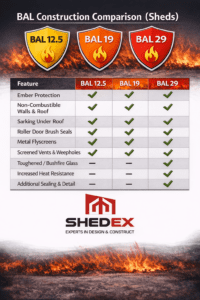
Our BAL rating post covered the CFS rule that forces a close-in shed to match the house. Here’s the flip side: what happens once your shed sits more than 6 metres away.
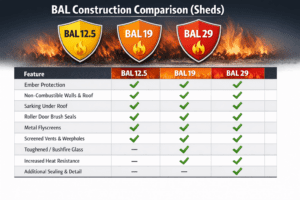
Our last post covered when a shed needs a BAL rating at all. This one’s the practical follow-up — a real walkthrough of what BAL-12.5 and BAL-19 actually mean for the shed itself, using real examples rather than a list of standards.
A lot of people assume bushfire ratings only apply to houses. On parts of the Fleurieu, that overlay can follow you all the way to the shed — and there’s a specific CFS rule that catches people out. Here’s what it means.
More Fleurieu homeowners are choosing to improve, not move — upgrading their existing home with sheds, garages and outdoor living spaces instead of relocating.
A garage should fit more than just your cars. Learn how to choose the right garage width, depth and height for modern vehicles, storage and the way you’ll actually use the space.
Building a shed without council approval can lead to costly problems. Learn when approval is required in South Australia, what exemptions may apply and how ShedEx Fleurieu makes the process easy.